Ultrasonic Level Sensor Supplier
Ultrasonic Level Sensor Supplier: A Technical Guide to Selection and Application
In the landscape of industrial automation, accurate level measurement is a cornerstone of process efficiency, safety, and inventory management. Among the various technologies available, ultrasonic measurement has emerged as a preferred non-contact solution for a wide range of liquid and solid applications. Selecting the right ultrasonic level sensor supplier involves more than just comparing hardware specifications; it requires an understanding of the underlying physics, application constraints, and the technical support capabilities of the manufacturer.
As a professional manufacturer of industrial level measurement instruments, Welk provides high-performance Ultrasonic Level Meters designed for reliability in water treatment, chemical processing, and industrial automation. This guide provides an engineering-focused overview of ultrasonic technology to assist procurement and technical teams in making informed decisions.
Understanding the Measurement Principle
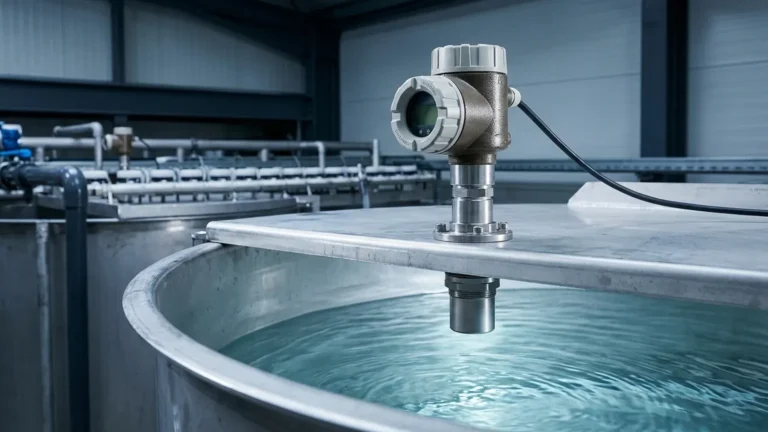
Ultrasonic level meters operate based on the "Time-of-Flight" (ToF) principle. The device's transducer emits a high-frequency ultrasonic pulse toward the surface of the medium. This sound wave travels through the air, reflects off the surface of the material, and returns to the transducer.
The sensor measures the time interval ($t$) between the emission of the pulse and the reception of the echo. Since the speed of sound in air ($v$) is a known constant (approximately 340 meters per second at 20°C), the distance ($D$) between the sensor and the surface can be calculated using the formula:
$$D = \frac{v \times t}{2}$$
The actual level ($L$) of the material in the tank is then determined by subtracting the measured distance from the total height of the vessel ($H$):
$$L = H – D$$
The Role of Temperature Compensation
Because the speed of sound is affected by air temperature (increasing by approximately 0.6 m/s for every degree Celsius increase), professional-grade sensors include integrated temperature probes. These probes allow the internal microprocessor to calculate real-time corrections, ensuring accuracy remains consistent despite environmental fluctuations.
Key Criteria for Evaluating an Ultrasonic Level Sensor Supplier
When identifying a reliable ultrasonic level sensor supplier, engineers should look beyond the unit price and evaluate the following technical and operational factors:
1. Transducer Material and Chemical Compatibility
The transducer is the most critical component. Suppliers should offer a variety of housing materials, such as ABS, PVC, or PVDF, to ensure compatibility with corrosive chemicals or volatile organic compounds (VOCs). For acidic or alkaline environments, a sealed PVDF transducer is often required to prevent premature sensor failure.
2. Signal Processing and Echo Filtering
In complex industrial environments, internal tank structures like ladders, agitators, or inlet pipes can create "false echoes." A high-quality supplier provides instruments with advanced digital signal processing (DSP) algorithms. These features allow the user to "mask" fixed obstructions, ensuring the sensor tracks the true level of the medium rather than internal hardware.
3. Customization and OEM/ODM Services
Every industrial site has unique requirements regarding mounting threads, output signals (4-20mA, RS485/Modbus, HART), and power supply (24VDC or 220VAC). A versatile ultrasonic level sensor supplier like Welk offers OEM/ODM services to tailor the instrument’s physical and electronic configuration to specific project needs.
Technical Selection Table
Selecting the correct model requires matching the sensor's capabilities to the application's physical parameters. The following table outlines typical specifications for different grades of ultrasonic level meters.
| Feature | Standard Industrial Grade | Chemical Resistant Grade | Long-Range / Solids Grade |
| :— | :— | :— | :— |
| Measurement Range | 0.3m to 10m | 0.25m to 12m | 0.5m to 30m |
| Accuracy | ±0.5% of Full Scale | ±0.25% of Full Scale | ±0.5% to ±1.0% |
| Transducer Material | ABS / Nylon | PVDF / PTFE | Reinforced Polymer |
| Output Options | 4-20mA, Relay | 4-20mA, Modbus RTU | 4-20mA, HART, RS485 |
| Beam Angle | 8° to 12° | 6° to 9° | 5° to 8° |
| Protection Rating | IP65 / IP66 | IP67 / IP68 | IP66 / IP67 |
Installation Considerations and Best Practices
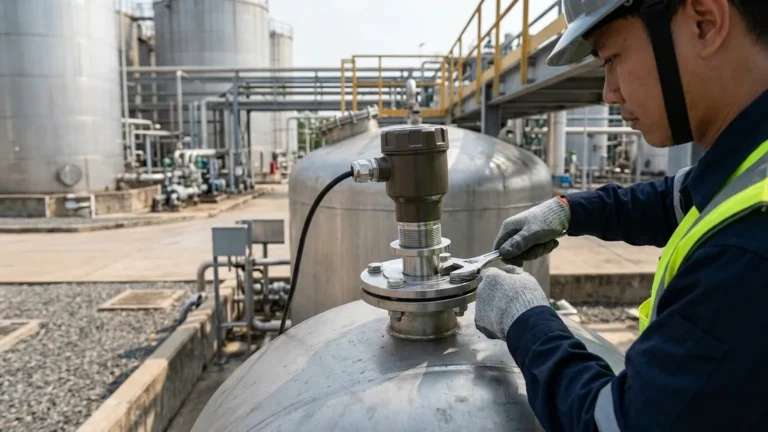
Even the most advanced sensor will fail to provide accurate data if installed incorrectly. To ensure optimal performance, follow these engineering guidelines:
Avoiding the Dead Zone (Blocking Distance)
Every ultrasonic sensor has a "dead zone" immediately below the transducer where it cannot receive an echo. This typically ranges from 0.2m to 0.6m depending on the frequency. The sensor must be mounted high enough so that the maximum liquid level never enters this zone.
Proper Positioning
* Vertical Alignment: The sensor must be mounted perfectly perpendicular to the liquid surface. A tilt of even a few degrees can cause the ultrasonic pulse to reflect away from the transducer, resulting in signal loss.
* Wall Clearance: Avoid mounting the sensor too close to the tank wall. The ultrasonic beam spreads as it travels (the beam angle). If the beam hits the wall, it creates noise and false readings. As a rule of thumb, the sensor should be placed at least 200mm from the wall for every 1 meter of depth.
* Inlet Interference: Never install the sensor directly above the filling inlet. The turbulence and falling liquid will disrupt the signal and cause erratic readings.
Mounting in Standpipes
If the liquid surface is turbulent or covered in light foam, installing the sensor inside a stilling well or standpipe can help. The pipe acts as a waveguide, focusing the signal and providing a smooth surface for measurement. However, the pipe must be smooth and free of burrs or joints on the inside.

Limitations and Environmental Challenges
While ultrasonic level meters are highly versatile, they are not universal solutions. A transparent ultrasonic level sensor supplier will advise against using this technology in the following scenarios:
* High Pressure or Vacuum: Ultrasonic waves require a medium (air or gas) to travel. In a vacuum, the sound cannot propagate. Conversely, high pressure changes the density of the air, significantly altering the speed of sound beyond what standard compensation can handle.
* Heavy Foam: Thick, dense foam absorbs the ultrasonic pulse rather than reflecting it. In these cases, a radar level meter or a hydrostatic transmitter is a more reliable choice.
* Extreme Dust: In silos containing fine powders (like flour or cement), heavy dust clouds can attenuate the signal. While high-power ultrasonic sensors can sometimes penetrate light dust, radar is generally preferred for high-dust solids.
* High Temperatures: Most ultrasonic transducers are limited to operating temperatures below 80°C (176°F). Excessive heat can damage the piezoelectric crystals and affect the accuracy of the time-of-flight calculation.
Why Source from a Specialized Manufacturer?
Working directly with a manufacturer like Welk ensures that you receive instruments built under strict quality control protocols. Industrial applications demand longevity; therefore, sourcing from a dedicated ultrasonic level sensor supplier provides access to:
1. Technical Validation: Assistance in calculating beam spread and ensuring the chosen sensor frequency (typically 20kHz to 60kHz) matches the required range and resolution.
2. Calibration Services: Factory calibration certificates that meet international standards, ensuring the device is ready for immediate deployment.
3. After-Sales Support: Rapid access to replacement parts and expert troubleshooting for complex installation environments.
Frequently Asked Questions (FAQ)
Q: Can ultrasonic level meters be used for solids?
A: Yes, but with limitations. Solids like grain or plastic pellets have an "angle of repose" that can deflect the signal. Sensors for solids usually require higher power and narrower beam angles to compensate for the uneven surface.
Q: How does wind affect outdoor installations?
A: Strong crosswinds can "blow" the ultrasonic pulse away, leading to intermittent signal loss. In outdoor tanks or open channels, using a protective sunshade or a stilling well can mitigate environmental interference.
Q: What is the difference between an ultrasonic transmitter and a switch?
A: An ultrasonic level transmitter provides a continuous measurement (e.g., 0-100% level via a 4-20mA signal), whereas an ultrasonic level switch only detects when the material reaches a specific point to trigger an alarm or pump.
Q: How often do these sensors require maintenance?
A: Because they are non-contact, maintenance is minimal. However, in high-humidity or dusty environments, the transducer face should be periodically inspected for condensation or buildup, which can be wiped away with a soft cloth.
For engineers and procurement professionals looking to optimize their process control, selecting the right Ultrasonic Level Meters is a balance of technical specification and environmental awareness. By partnering with a knowledgeable ultrasonic level sensor supplier, you ensure that your facility benefits from accurate, maintenance-free level detection for years to come.