Level Switch Radar Type
Level Switch Radar Type
In the field of industrial process control, the requirement for reliable point level detection is critical for preventing tank overfills, protecting pumps from dry running, and ensuring the seamless automation of material transfer. While traditional contact-based sensors have long dominated the market, the adoption of the level switch radar type has increased significantly. This non-contact technology offers a robust alternative for challenging environments where temperature, pressure, and material characteristics might cause mechanical or contact-based sensors to fail.
As a professional manufacturer of industrial level measurement instruments, Welk provides a range of Level Switches designed to meet the rigorous demands of modern industry. This article explores the technical principles, selection criteria, and practical installation considerations for radar-based level switching technology.
Understanding the Measurement Principles of Radar Level Switches
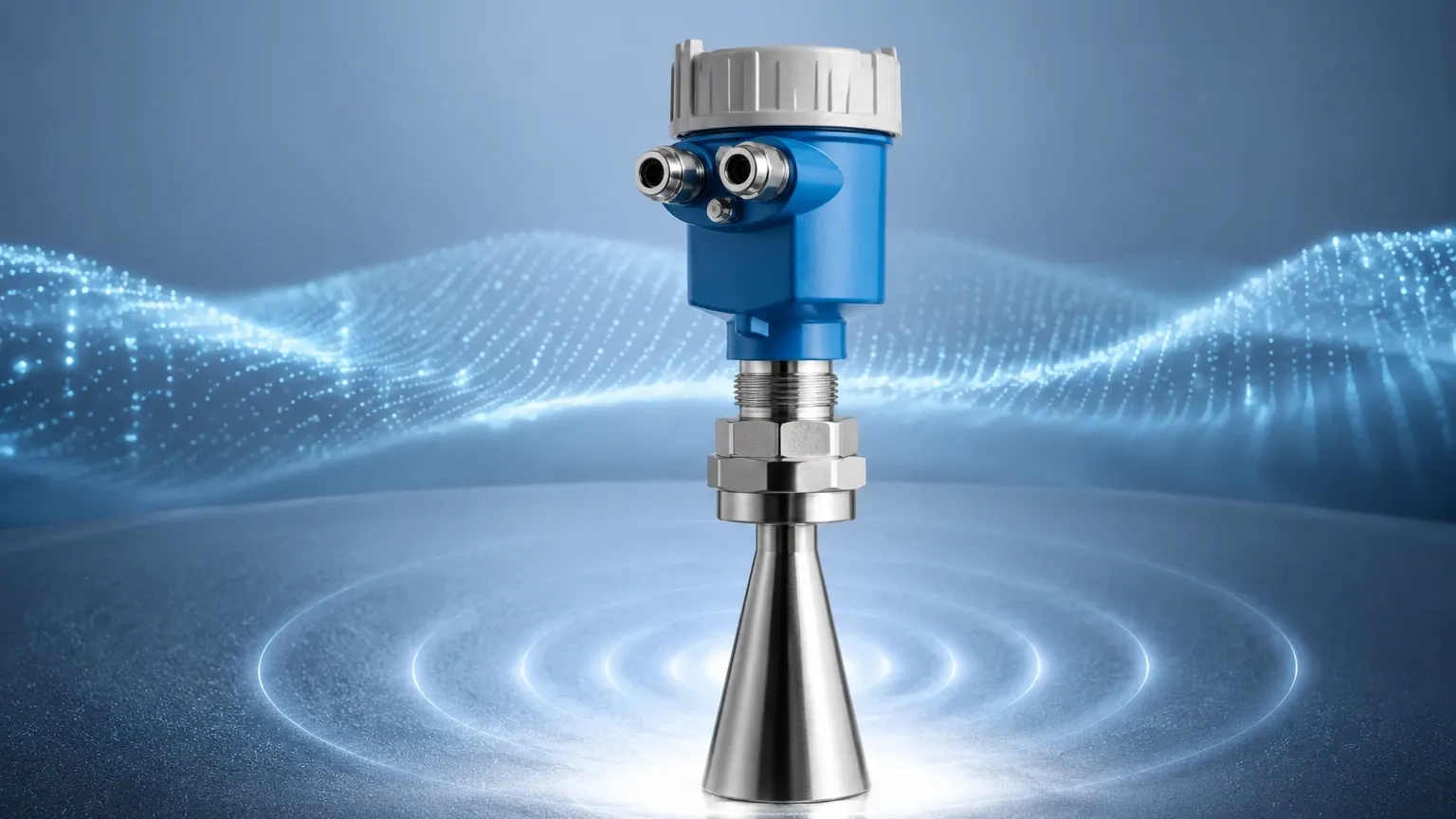
To effectively implement a level switch radar type, it is essential to understand the underlying physics of microwave measurement. Radar level instruments operate by emitting high-frequency electromagnetic waves (microwaves) toward the surface of a medium. These waves travel at the speed of light, reflect off the material surface, and return to the sensor antenna.
Time of Flight (ToF) and Pulse Radar
Most radar switches utilize the Time of Flight (ToF) principle. The sensor emits a short microwave pulse and measures the time interval between the emission and the reception of the reflected signal. Since the speed of light is constant, the distance ($D$) can be calculated using the formula:
$$D = \frac{c \times t}{2}$$
Where $c$ is the speed of light and $t$ is the measured time. In a switching application, the internal electronics compare this calculated distance against a pre-configured setpoint. When the material reaches the distance corresponding to the "switch point," the device triggers a relay or a digital output (such as PNP/NPN or 4-20mA step).
FMCW (Frequency Modulated Continuous Wave)
Advanced radar switches may use FMCW technology. Instead of short pulses, the transmitter emits a continuous signal with a constantly changing frequency (a frequency sweep). The reflected signal is received and mixed with the currently emitted signal. The frequency difference between the two is directly proportional to the distance. FMCW radar often provides higher accuracy and better signal-to-noise ratios, making it suitable for complex geometries or materials with low reflectivity.
The Role of Dielectric Constant ($ε_r$)
The success of a radar reflection depends on the dielectric constant of the medium. Materials with high $ε_r$ (such as water, $ε_r ≈ 80$) reflect radar waves very effectively. Materials with low $ε_r$ (such as hydrocarbons or plastic pellets, $ε_r < 2$) allow more waves to penetrate the medium, resulting in a weaker reflection. Modern radar switches are engineered with high sensitivity to detect materials with dielectric constants as low as 1.4.
Key Advantages of Radar Type Switches over Contact Methods
Choosing a level switch radar type over traditional technologies like tuning forks, floats, or capacitive probes offers several distinct engineering advantages:
1. Non-Contact Measurement: Because the sensor never touches the medium, it is immune to the effects of corrosive chemicals, viscous liquids that might coat a probe, or abrasive solids that would wear down a mechanical switch.
2. Immunity to Process Variations: Radar waves are largely unaffected by changes in process pressure, temperature, or the presence of vapors and gases. Unlike ultrasonic sensors, radar does not require a medium (like air) to travel through, meaning it performs reliably in a vacuum.
3. No Moving Parts: Mechanical switches, such as float switches, are prone to jamming or fatigue. Radar switches are solid-state devices, significantly reducing maintenance requirements and increasing the Mean Time Between Failures (MTBF).
4. High Temperature and Pressure Resilience: Radar antennas can be isolated from the process using PTFE or ceramic windows, allowing the electronics to operate safely while the process reaches temperatures exceeding 250°C and pressures up to 40 bar (4.0 MPa).
Selection Criteria for Radar Level Switches
When selecting a level switch radar type for a specific application, engineers must evaluate several technical parameters. The following table provides a comparison between radar switches and other common point-level technologies.
Technology Comparison Table
| Feature | Radar Level Switch | Tuning Fork Switch | Ultrasonic Switch | Float Switch |
| :— | :— | :— | :— | :— |
| Measurement Type | Non-contact | Contact | Non-contact | Contact |
| Moving Parts | None | Vibration | None | Yes |
| Media Coating | Unaffected | Sensitive | Unaffected | Highly Sensitive |
| Dielectric Dependency | Yes (Low $ε_r$ is harder) | No | No | No |
| Vacuum Suitability | Excellent | Good | Not Suitable | Good |
| Maintenance Level | Low | Moderate | Low | High |
Frequency Selection: 24GHz vs. 80GHz
The frequency of the radar switch dictates the beam angle and the size of the antenna.
* 24GHz Radar: Generally features a wider beam angle. It is robust against heavy dust or steam but requires a larger mounting nozzle to avoid interference from tank walls.
* 80GHz Radar: Offers a very narrow beam angle (often as small as 3° to 6°). This is ideal for small tanks, vessels with internal obstructions (like agitators or heating coils), and for mounting on narrow nozzles.
Installation and Engineering Considerations
Proper installation is paramount to ensuring the reliability of a level switch radar type. Even the most advanced sensor will fail if the signal path is obstructed or if the mounting geometry creates false reflections.
1. Beam Angle and Obstructions
The radar signal spreads in a cone shape. Any metal object within this cone—such as ladders, pipes, or agitator blades—will create a reflection. If these reflections are stronger than the reflection from the material surface, the switch may trigger prematurely.
* Rule of Thumb: Install the sensor at a distance from the wall that is at least 1/6th of the tank height, and ensure the signal path is clear of internal structures.
2. The Blocking Distance (Dead Zone)
Every radar switch has a "dead zone" or blocking distance directly beneath the antenna (typically 50mm to 200mm). In this zone, the sensor cannot accurately process reflections. When setting a high-level alarm, the switch point must be located outside this dead zone to prevent signal loss when the tank is full.
3. Nozzle Geometry
The mounting nozzle should be as short as possible. If a long nozzle is necessary, the inner surface must be smooth, and the antenna should ideally extend slightly beyond the bottom of the nozzle to prevent "ringing" or internal reflections within the pipe.
4. Orientation and Polarization
Radar waves are polarized. Rotating the sensor in its mounting can sometimes help minimize reflections from nearby obstructions. Most radar switches include a marking on the housing to indicate the direction of polarization.
Common Challenges and Limitations
While highly versatile, the level switch radar type is not a universal solution for every scenario. Engineers should be aware of the following limitations:
* Extremely Low Dielectric Materials: For materials like liquid hydrogen or certain dry powders with $ε_r < 1.4$, the reflected signal may be too weak for a standard radar switch to detect. In these cases, a guided wave radar (GWR) or a high-sensitivity capacitive switch may be required.
* Heavy Foam: Dense, thick foam can absorb or scatter radar signals. While radar can often see through light foam to the liquid level below, heavy fire-fighting type foam may be detected as the "level" itself, or it may attenuate the signal entirely.
* Internal Tank Geometry: In very small, complex vessels, the multiple reflections (multipath interference) can make it difficult for the switch to distinguish the true level. Utilizing an 80GHz sensor with a narrow beam is the primary mitigation strategy here.
Frequently Asked Questions (FAQs)
Q1: Can a radar level switch be used for both liquids and solids?
Yes. Radar technology is effective for both liquid and solid applications. However, for solids, the angle of repose (the slope of the material pile) must be considered, as it can deflect the radar signal away from the receiver. High-frequency 80GHz radar is typically preferred for solids due to its better focus.
Q2: Does the color or transparency of the liquid affect the radar switch?
No. Unlike optical or laser sensors, radar waves are not affected by the optical properties of the medium. A radar switch will work equally well on clear water, opaque oil, or dark chemicals.
Q3: How do I calibrate a radar level switch?
Most modern radar switches, such as those from Welk, are calibrated via a digital interface (HART, Bluetooth, or specialized software) or via push-buttons on the device. You simply define the distance from the sensor face to the desired switch-on and switch-off points.
Q4: Is a radar switch safe for use in explosive atmospheres?
Yes, many radar switches are available with ATEX, IECEx, or North American intrinsic safety (IS) or explosion-proof (Ex d) certifications, making them suitable for oil and gas or chemical processing environments.
Conclusion
The level switch radar type represents a significant advancement in point level detection, providing a maintenance-free, non-contact solution for the most demanding industrial applications. By understanding the dielectric properties of the media and adhering to strict installation guidelines regarding beam angles and dead zones, engineers can implement highly reliable overfill and dry-run protection systems.
For those seeking precise and cost-effective measurement solutions, exploring the variety of Level Switches available is the first step toward optimizing process safety and efficiency. Whether dealing with corrosive acids in water treatment or high-temperature hydrocarbons in the oil and gas sector, radar technology offers the durability and accuracy required for modern industrial automation.