Level Switch Tuning Fork Type
Level Switch Tuning Fork Type
In the landscape of industrial automation, point level detection serves as a critical safeguard against tank overfills, dry-run conditions in pumps, and inventory inaccuracies. Among the various technologies available, the level switch tuning fork type—also known as a vibrating fork level switch—has emerged as one of the most versatile and reliable solutions for both liquid and solid applications.
Characterized by its "fit and forget" nature, this technology utilizes the physical principles of resonance to determine the presence or absence of a medium. Unlike mechanical float switches that are prone to jamming or capacitive sensors that may require frequent recalibration, tuning fork switches offer a robust alternative that remains largely unaffected by the dielectric constant, turbulence, or bubbles within the process. This guide provides a comprehensive technical overview of the tuning fork level switch, its operating principles, selection criteria, and installation best practices.
Measurement Principle: The Physics of Vibration
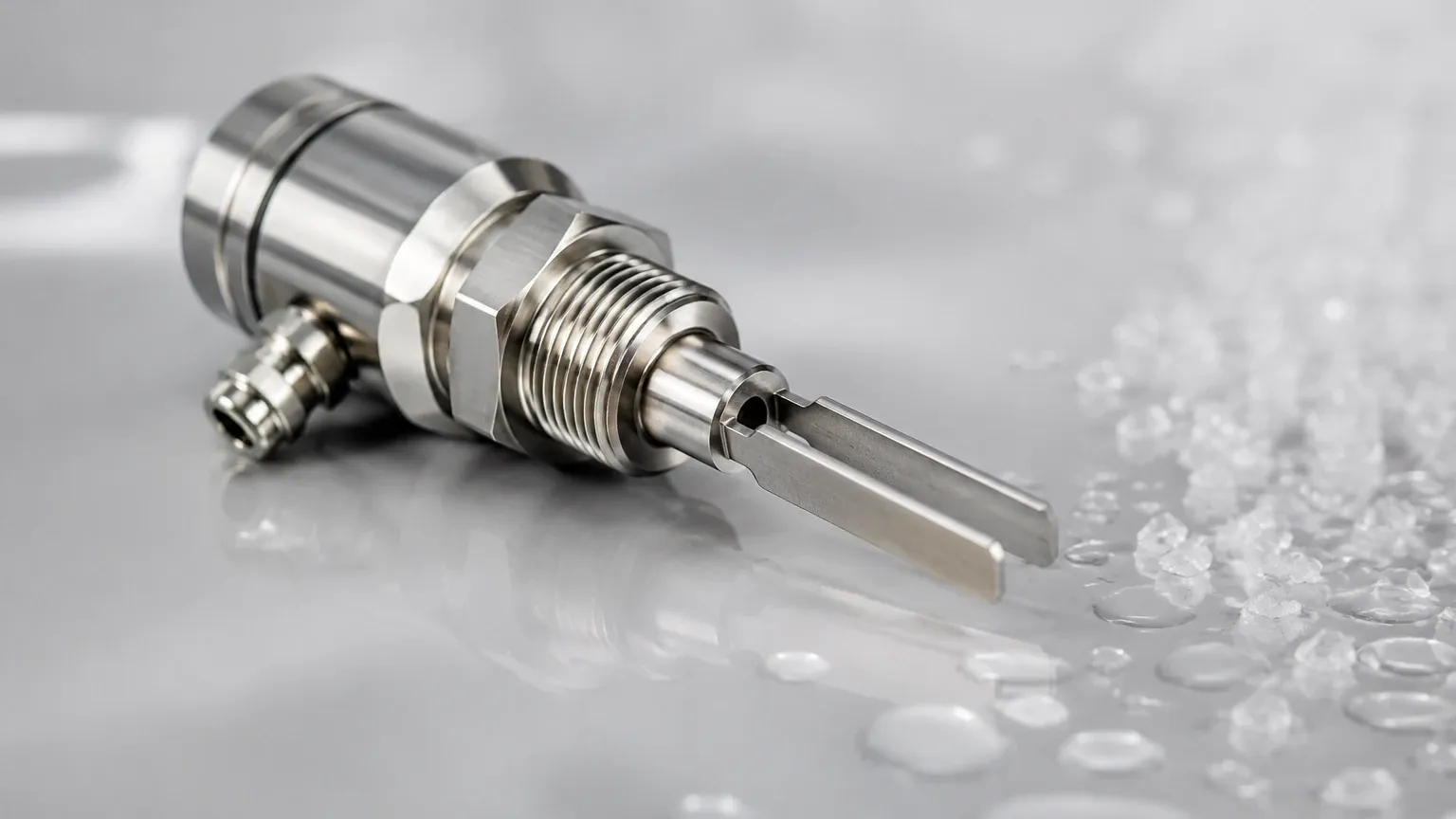
To understand why the Level Switches of the tuning fork variety are so effective, one must first examine the underlying physics. The device consists of a sensing element shaped like a two-pronged fork, which is driven by internal piezoelectric crystals.
Resonance and Frequency Shift
The electronics within the switch housing excite the piezoelectric crystals, which in turn cause the fork to vibrate at its natural resonance frequency in free air. For most industrial models, this frequency typically ranges between 300 Hz and 1200 Hz, depending on whether the unit is designed for liquids or solids.
When the medium (liquid or powder) reaches the level of the fork and begins to submerge the prongs, the vibration frequency changes.
1. In Liquids: The density of the liquid acts as a mass load on the fork, causing the vibration frequency to decrease significantly.
2. In Solids: The material surrounds the fork and dampens the amplitude of the vibration or shifts the frequency through mechanical resistance.
The internal electronics continuously monitor these changes. Once the frequency or amplitude shifts beyond a pre-defined threshold, the processor triggers an output signal—typically a relay, a transistor (PNP/NPN), or a 2-wire NAMUR signal—to indicate a "covered" state.
Key Advantages of the Tuning Fork Design
The level switch tuning fork type is preferred in modern process engineering due to several distinct advantages over traditional point level sensors:
* No Calibration Required: Unlike capacitive sensors, which must be calibrated to the specific dielectric constant of the medium, tuning fork switches are generally independent of the material's electrical properties. They work equally well with water, oils, and chemical solvents.
* Immunity to Process Conditions: The high-frequency vibration of the fork makes it resistant to the effects of turbulence, foam, and air bubbles, which often cause false readings in ultrasonic or optical sensors.
* Minimal Maintenance: With no moving parts like hinges or pivots (common in float switches), there is no mechanical wear and tear, significantly reducing the risk of failure in high-cycle applications.
* Self-Cleaning Property: The constant vibration of the fork prongs provides a slight self-cleaning effect, which can prevent the buildup of minor coatings or residues that might otherwise interfere with the measurement.
Selection Criteria for Industrial Applications
Selecting the correct level switch tuning fork type requires a thorough analysis of the process environment. Engineers should evaluate the following parameters before procurement:
1. Medium Density (Specific Gravity)
Every tuning fork switch has a minimum density threshold. For liquids, this is typically around 0.5 g/cm³ (500 kg/m³), though high-sensitivity models can detect lighter fluids like Liquefied Petroleum Gas (LPG). For solids, the bulk density of the powder or granules must be sufficient to dampen the fork's vibration.
2. Viscosity
While tuning forks are highly versatile, extremely viscous liquids (e.g., heavy resins or thick syrups) can cause "clinging," where the medium remains on the fork even after the level has dropped. Generally, liquids with a viscosity up to 10,000 mm²/s (cSt) can be handled, but special fork geometries may be required for higher ranges.
3. Temperature and Pressure
Standard industrial models are designed for temperatures ranging from -40°C to 150°C (-40°F to 302°F) and pressures up to 40 bar (580 PSI). For extreme environments, such as steam boilers or cryogenic storage, specialized high-temperature extensions or high-pressure housings must be specified.
4. Material Compatibility
The wetted parts are most commonly manufactured from 316L Stainless Steel. However, for corrosive chemical applications involving acids or bases, coatings like PFA or materials like Hastelloy C are available to ensure long-term durability.
5. Output and Power Requirements
Engineers must match the switch output to the control system (PLC or DCS). Common options include:
* Relay (SPDT/DPDT): For direct switching of pumps or alarms.
* Transistor (PNP/NPN): For high-speed digital inputs.
* Two-wire (8/16mA): For loop-powered integration.
Comparison Table: Tuning Fork vs. Other Technologies
| Feature | Tuning Fork Switch | Float Switch | Capacitive Switch | Ultrasonic Point Level |
| :— | :— | :— | :— | :— |
| Moving Parts | No | Yes | No | No |
| Calibration | Not Required | Not Required | Required | Required |
| Foam Sensitivity | Low | Low | High | High |
| Build-up Resistance | Moderate | Low | Low | Moderate |
| Maintenance | Very Low | High | Moderate | Moderate |
| Cost | Moderate | Low | Moderate | High |
Installation and Engineering Best Practices
Proper installation is paramount to ensuring the reliability of a level switch tuning fork type. Incorrect mounting can lead to false alarms or physical damage to the instrument.
Orientation and Positioning
* Top Mounting: When installed from the top of a tank, the fork should be positioned so that the prongs are clear of any internal structures or agitator blades. If the tank is filled from the top, ensure the fork is not directly in the path of the falling material stream.
* Side Mounting: This is the most common orientation for point level detection. In liquid applications, the prongs should be oriented vertically (one above the other) to allow the liquid to drain freely when the level drops. For solids, the prongs should be oriented such that the flat surfaces are vertical to prevent material from "bridging" or resting on top of the fork.
Avoiding Build-up and Obstructions
* Nozzle Length: Ensure the nozzle (the pipe section where the switch is screwed in) is short enough that the fork prongs protrude fully into the tank. If the prongs are recessed inside a long nozzle, material can become trapped, leading to a permanent "covered" signal.
* Distance from Walls: Maintain a minimum distance of 20 mm (0.8 inches) from the tank wall to prevent interference with the vibration pattern.
Protective Measures
In silos containing heavy granules or rocks, a protective shield or baffle should be installed above the fork. This shield deflects the weight of the falling material, preventing mechanical deformation of the prongs while still allowing the material to flow around the sensor for detection.
Limitations and Application Constraints
Despite its versatility, the level switch tuning fork type is not a universal solution. It faces limitations in specific scenarios:
1. Heavy Coating/Bridging: If a medium is extremely sticky and creates a solid bridge between the two prongs, the switch will remain in the "alarm" state even if the tank is empty. In such cases, a flush-mounted capacitive or microwave sensor may be more appropriate.
2. Extremely Low Density: Very light powders (fumed silica, for example) may not have enough mass to dampen the vibration of a standard tuning fork. High-sensitivity forks with larger surface areas are required for these applications.
3. Large Particle Sizes: In mining or aggregate industries, stones larger than the gap between the prongs can become wedged, causing mechanical failure or false signals.
Maintenance and Troubleshooting
Because there are no moving parts, maintenance is primarily focused on visual inspections. During scheduled shutdowns, the fork should be checked for signs of corrosion, erosion (in abrasive slurries), or excessive material buildup.
Common Troubleshooting Steps:
* False Positive (Switch stays on): Check for material bridging between prongs or significant coating. Verify that the prongs are not bent and touching each other.
* False Negative (Switch stays off): Ensure the power supply matches the technical specifications. Check if the medium density has changed and is now below the switch's minimum threshold.
* Intermittent Signals: This is often caused by heavy turbulence or the fork being mounted too close to a filling inlet. Adjusting the switching delay (if the electronics allow) can often filter out these momentary fluctuations.
Frequently Asked Questions (FAQs)
Q: Can a tuning fork switch be used for both high and low-level detection?
A: Yes. The same device can be used for high-level (overfill) or low-level (dry-run) protection. Most units feature a selectable "Fail-Safe" mode (High or Low) via a switch on the internal electronics to ensure the relay de-energizes in a safe state during a power failure.
Q: Does the orientation of the prongs matter in liquid applications?
A: Yes. In horizontal installations, it is recommended to align the prongs vertically. This prevents the liquid from being "trapped" between the prongs by surface tension, ensuring a clean break in the signal when the level recedes.
Q: Can these switches operate in hazardous areas?
A: Most professional manufacturers provide versions with ATEX, IECEx, or CSA certifications for use in explosive gas or dust atmospheres. These typically utilize Intrinsic Safety (Ex i) or Flameproof (Ex d) protection methods.
Q: How does the tuning fork handle foam?
A: In most cases, the tuning fork will ignore light, airy foam and only trigger when it contacts the actual liquid surface. However, if the foam is extremely dense and "wet," it may provide enough damping to trigger the switch. Testing with the specific medium is recommended for heavy foam applications.
Conclusion
The level switch tuning fork type represents a pinnacle of reliability for point level monitoring in the chemical, food and beverage, and water treatment industries. By understanding the vibration principles and matching the sensor material and sensitivity to the specific process medium, engineers can implement a solution that requires minimal intervention over a long service life. Whether protecting a pump from running dry or preventing an environmental disaster caused by an oil tank overflow, the tuning fork remains a foundational component of modern industrial safety and efficiency.